See the highlights of Congaree National Park’s unique ecosystem along the Boardwalk Loop Trail!
This easy-to-access trail starts right next to the visitors center, making it a great choice for travelers short on time or families looking for a kid-friendly trail.
While the 2 mile loop is light on distance, it’s packed with interesting features: knobby cypress knees, towering champion trees, wildlife, and lake views.
It’s a must do for anyone visiting this South Carolina national park.
In the guide below, you’ll learn everything you need to know in order to plan your hike along this trail, including what to bring, trail conditions, and what to expect at every step.
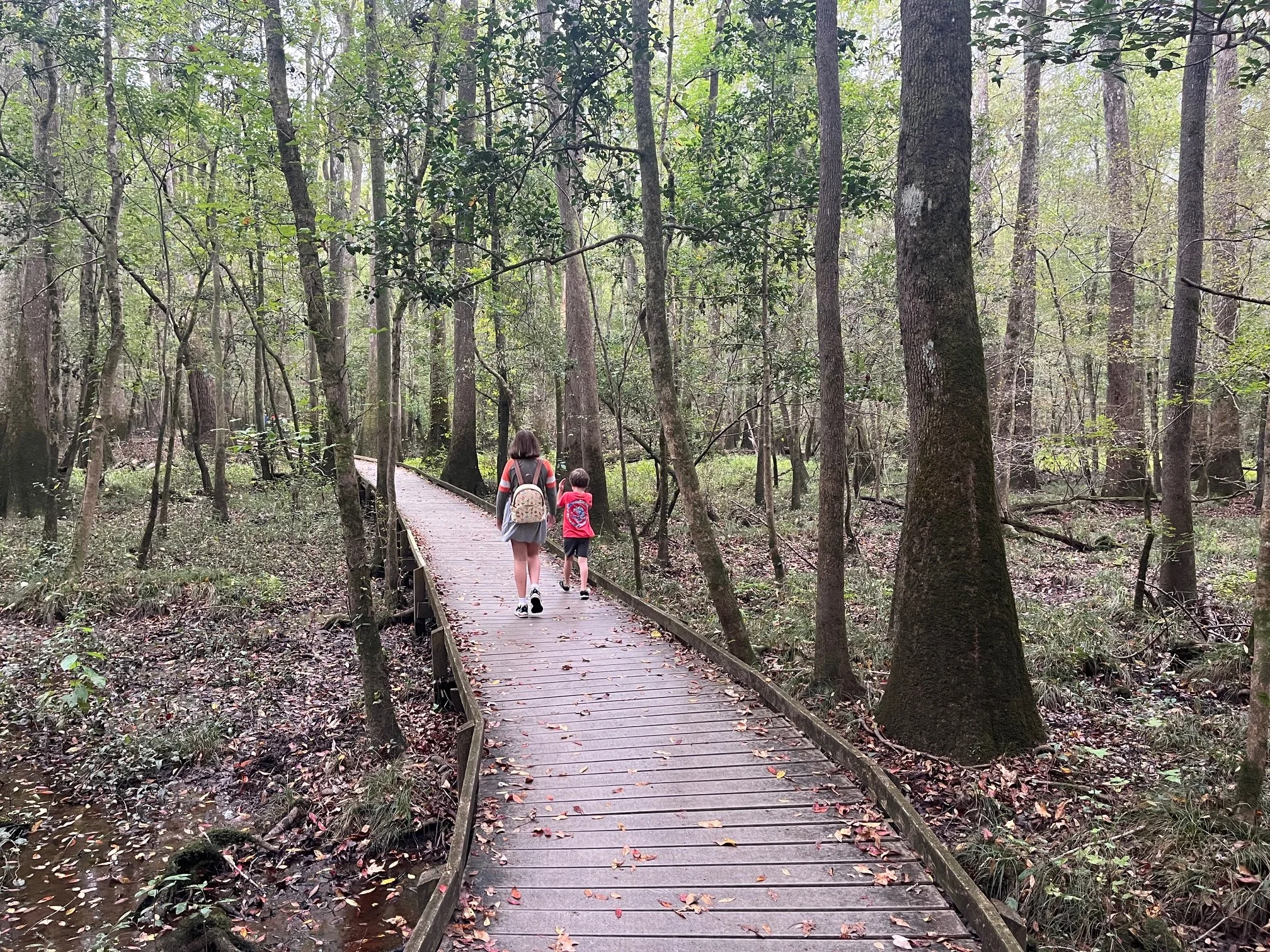
The Camping Kiddos on the Boardwalk Loop Trail at Congaree National Park
This post contains affiliates. If you purchase through the links below, I will receive a commission at no charge to you.
Hike Overview
Trailhead Location: next to the visitors center at Congaree National Park in South Carolina
Trail length: 2 mile loop
Trail difficulty: easy
Elevation gain: 10 feet
Getting to the Boardwalk Loop Trail and Parking
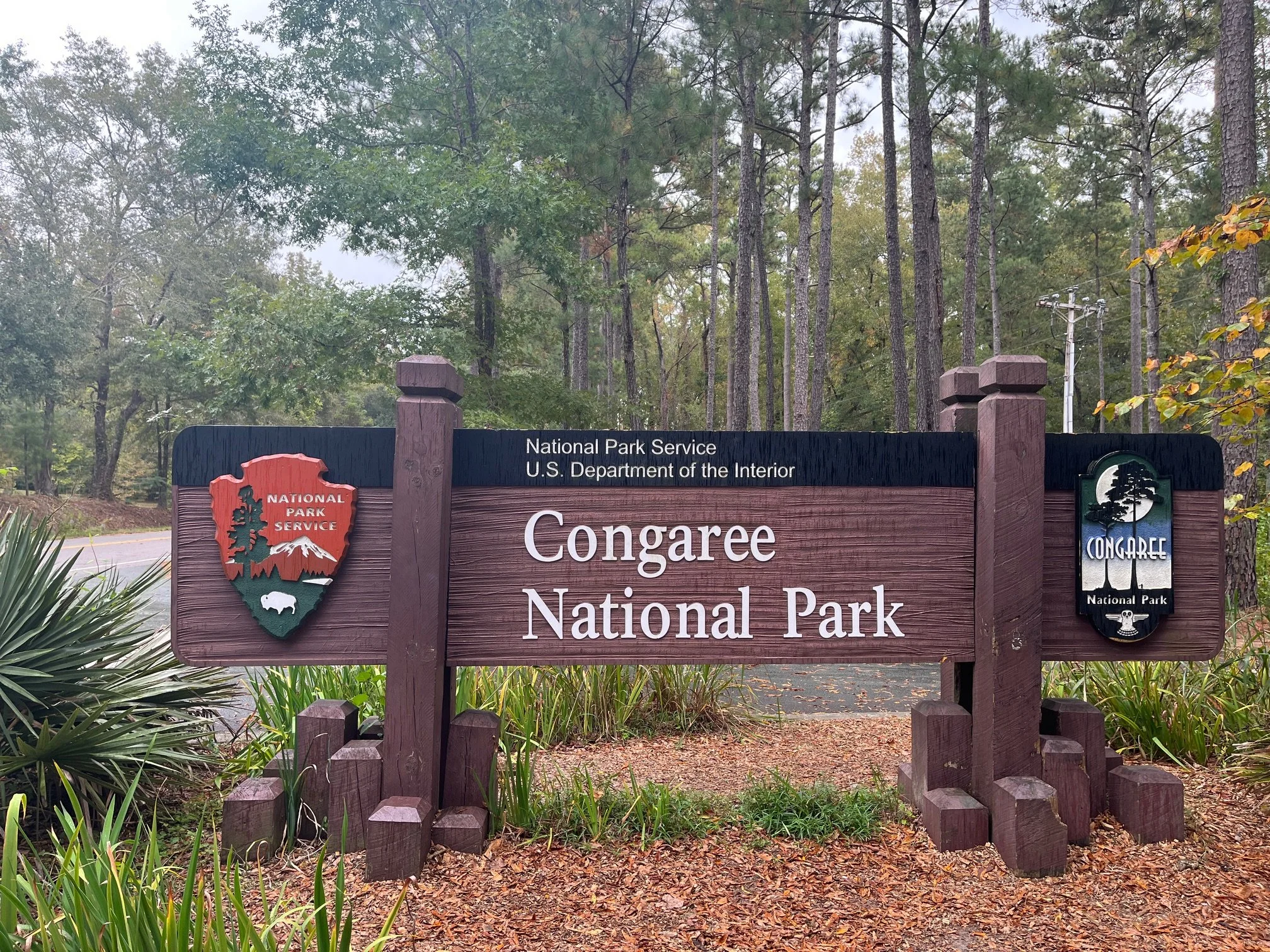
The entrance sign on Bluff Road
The Boardwalk Trail is located inside South Carolina’s only national park.
Despite what social media might lead you to believe, Congaree is not the worst national park and it is absolutely worth a visit.
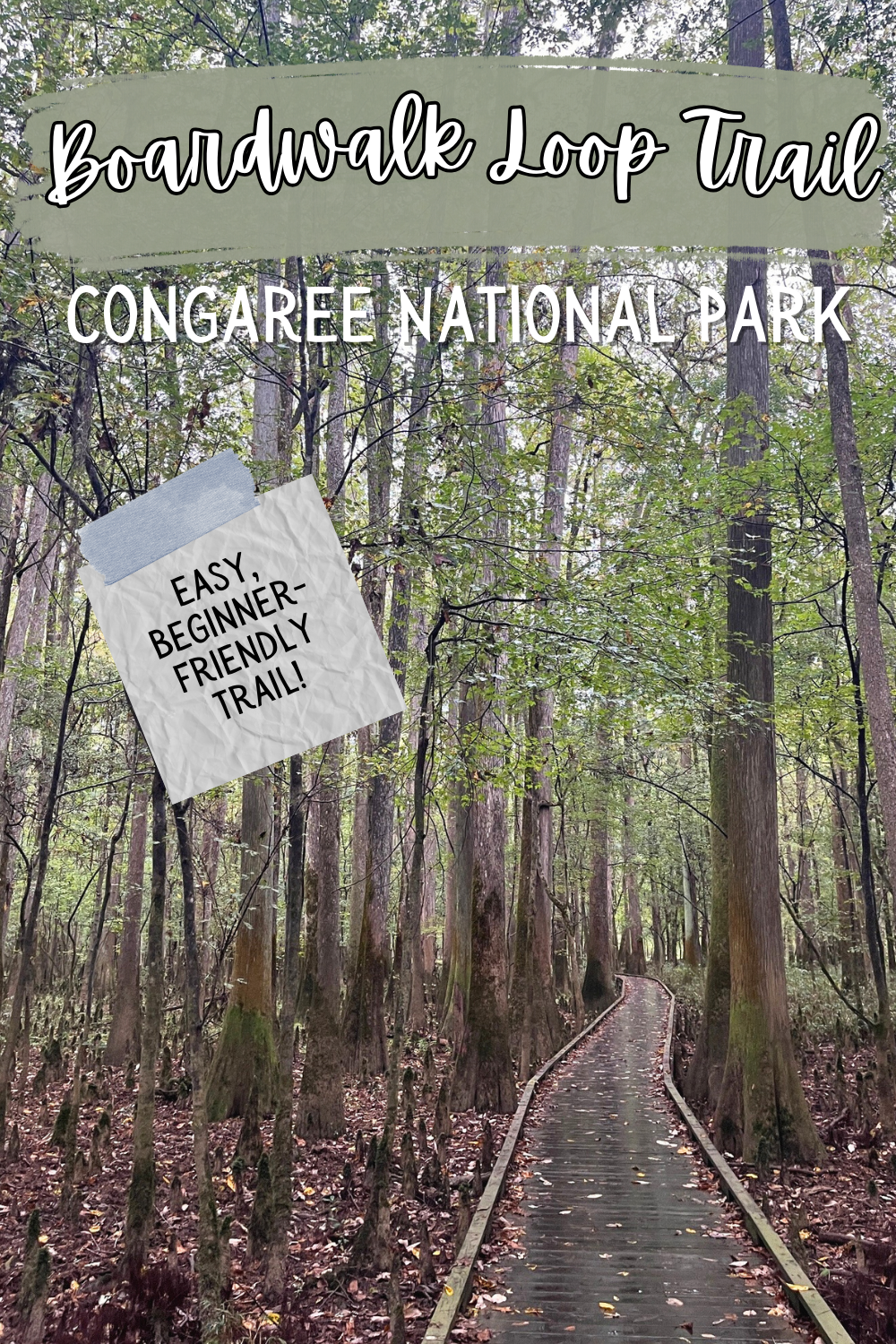
PIN ME!
We live in South Carolina and love visiting Congaree whenever we have a free afternoon. Since it’s “our” park, I feel a little protective of it and want to encourage others to enjoy it, too!
It doesn’t have flashy overlooks or towering mountains, but there’s still plenty here that’s worth your time, I promise.
The park’s 26,000 acres protects multiple champion trees, which are some of the tallest on the entire East Coast. Plus, the old growth hardwood forest protected here has all but disappeared elsewhere in the South, thanks to overzealous logging.
Yet, with such a pristine wilderness awaiting you in Congaree, it’s surprisingly easy to access from multiple interstates.
You can take I-26 to the Orangeburg, South Carolina, exit, and then cut through St. Matthews and Lone Star to access the park if you’re coming from Charleston.
Or, you can take exit 5 on I-77 outside of Columbia, South Carolina, following Bluff Road to the turn off for the national park.
From Bluff Road (coming from either direction), turn onto Old Bluff Road, then turn by the large wooden Congaree sign onto National Park Road.
Congaree National Park is a fee-free park, so you won’t see an entrance station.
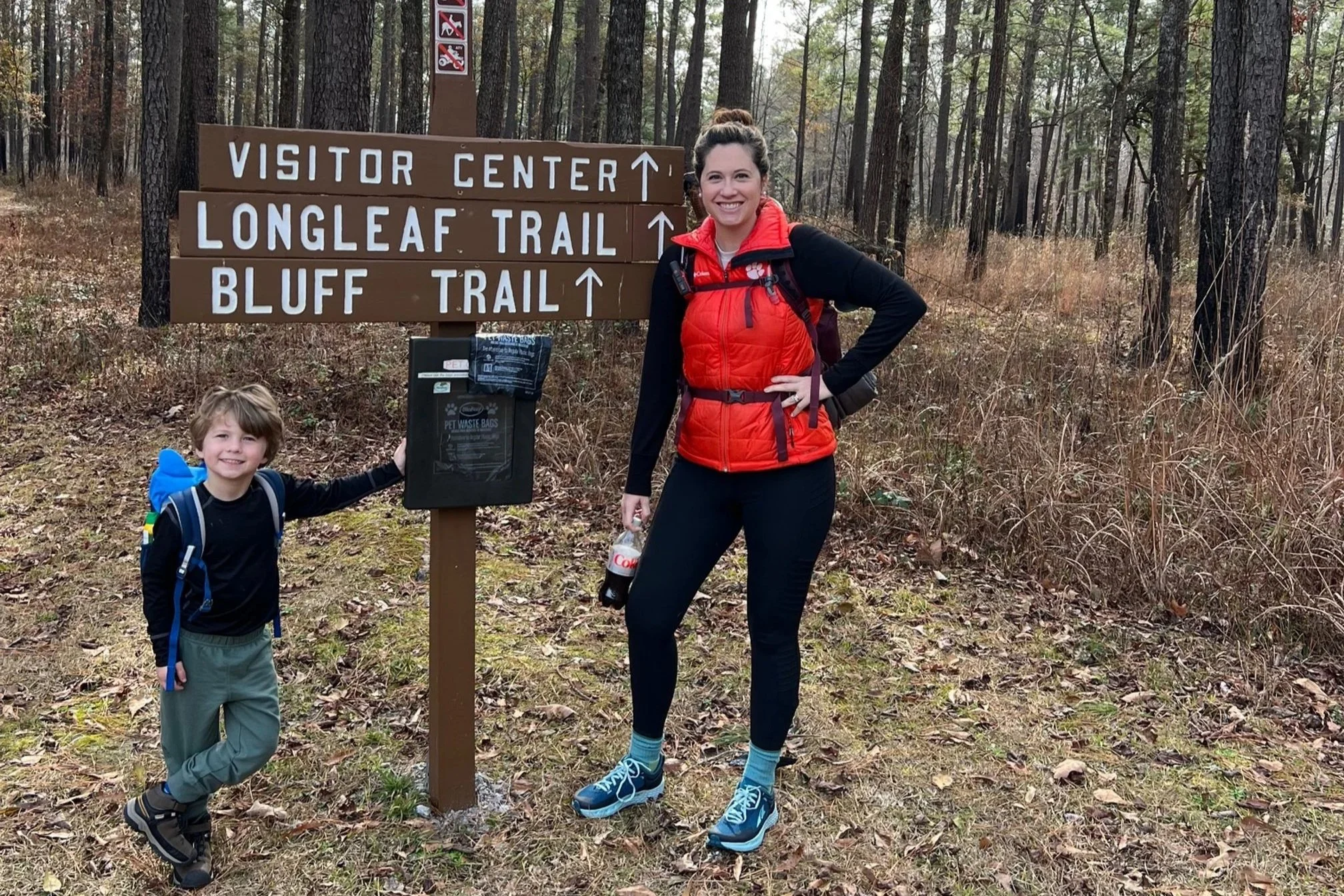
Drive into the park, staying on the main road. You’ll pass the parking area for the Longleaf campground on your way, but follow signs for the visitors center.



Parking for Boardwalk Loop Trail
You’ll come to a large parking area with multiple entrances near the end of the road. Turn here.
There should be ample space for you to park as Congaree never gets super busy, but visitor numbers are growing. If you’re driving an RV, there are a handful of designated parking spots in the last parking area.
There isn’t any fee for parking.
FREE Congaree National Park planning resources!
From camping reviews to kid-friendly itineraries, you’ll find all of my Congaree National Park vacation guides here.
Boardwalk Loop Trail, Step-by-Step
TIP: Before you set out on any hike, it’s a good idea to check for any recent updates, trail conditions, and level of difficulty at AllTrails! Purchase your annual subscription here.
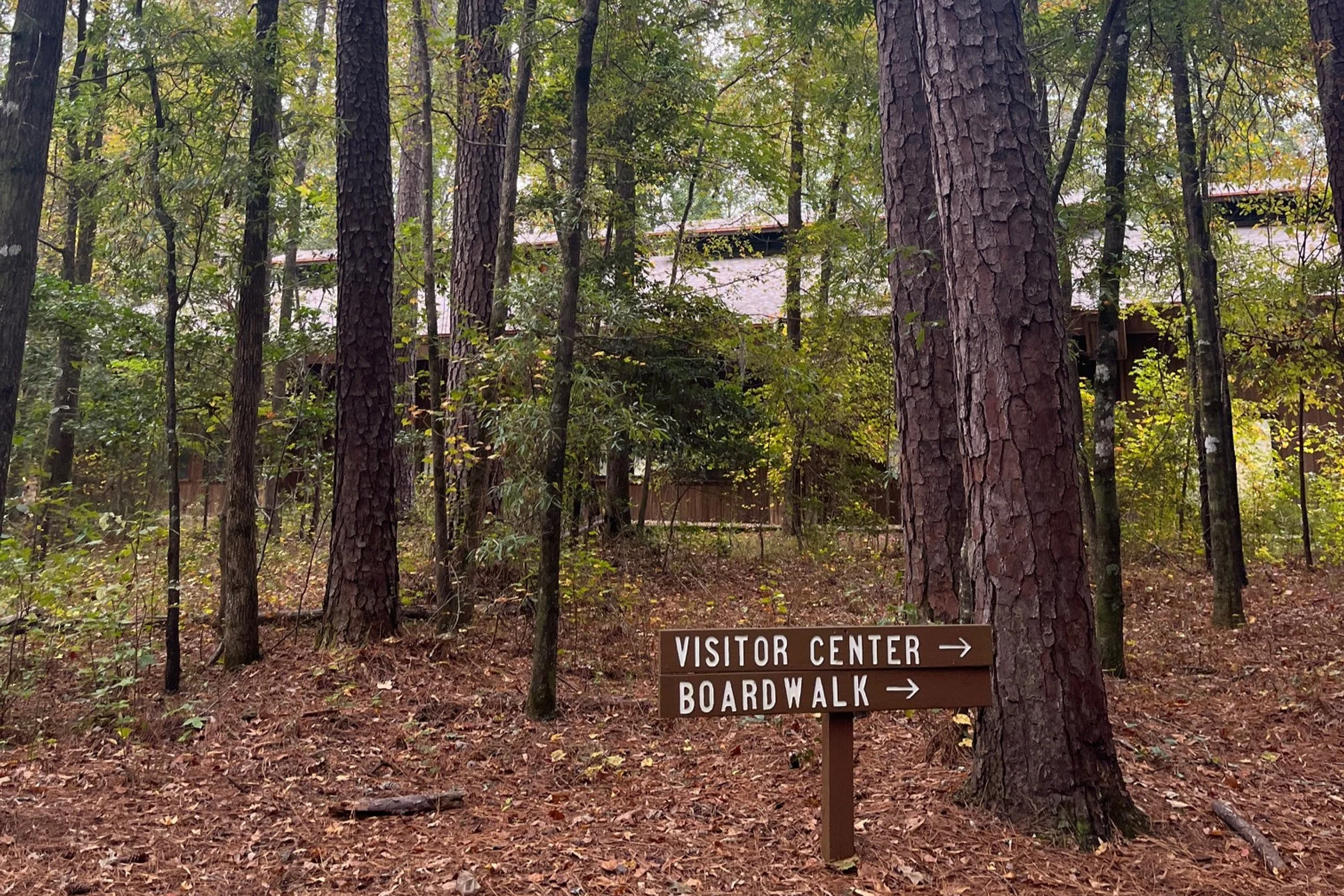
Helpful signs on the edge of the parking area
To access the trailhead for this hike, walk up to the visitors center complex from the parking area, pass under the covered area near the bathrooms, and follow the boardwalk around to your right.
Stay on the boardwalk, and don’t go down the sets of stairs that you’ll pass. These take you to other areas of the park, including the Firefly Trail, which is where the incredible synchronous firefly display at Congaree occurs each spring.
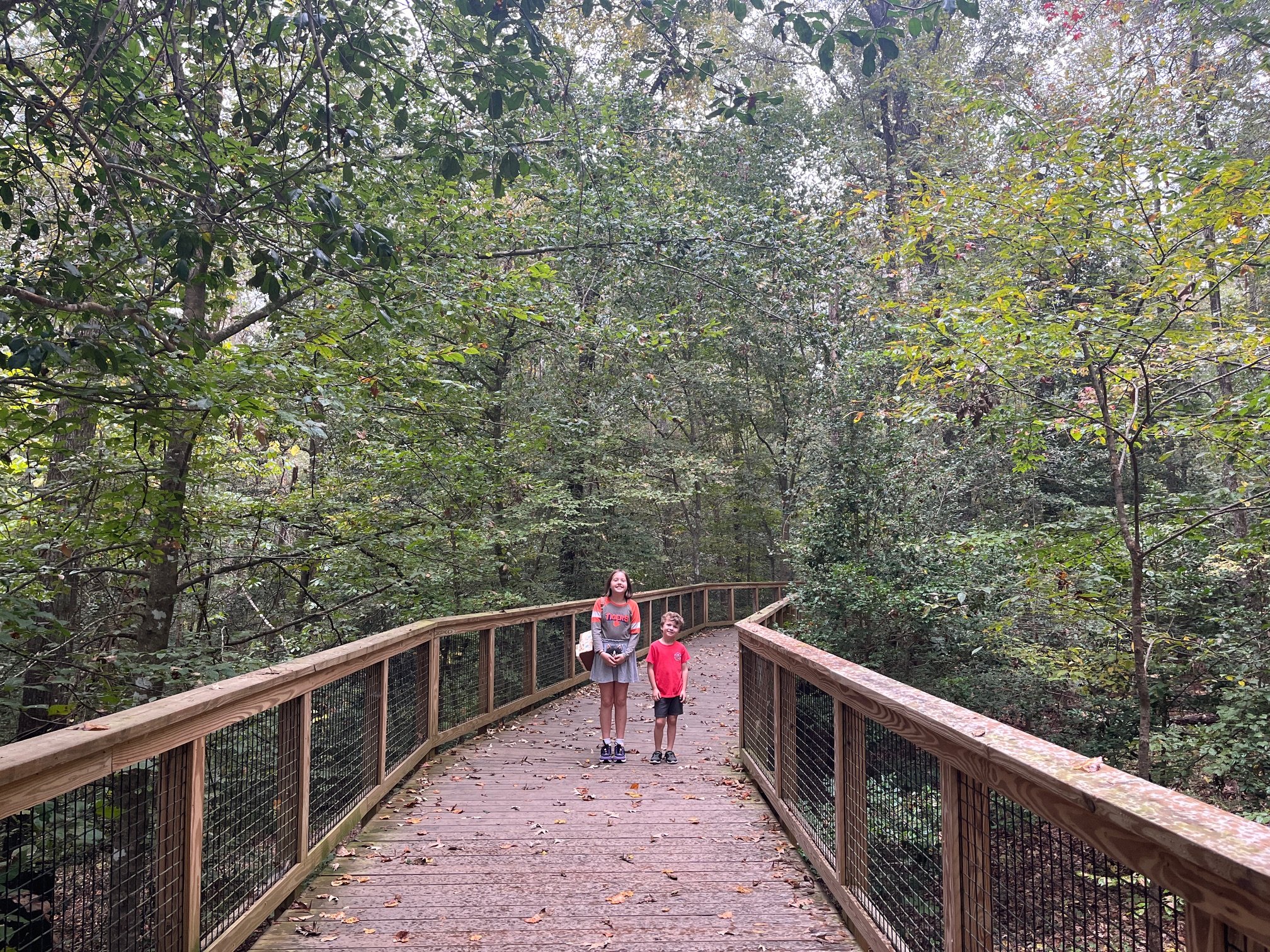
The Camping Kiddos on the portion of the Boardwalk Loop near the visitors center
You’ll come to a spacious area with bench seating on the boardwalk.
Just past this area, the boardwalk will fork. You can do this hike in either direction, but I’ll be sharing what you’ll encounter as you go counterclockwise, purely because it’s my favorite way to hike the trail.
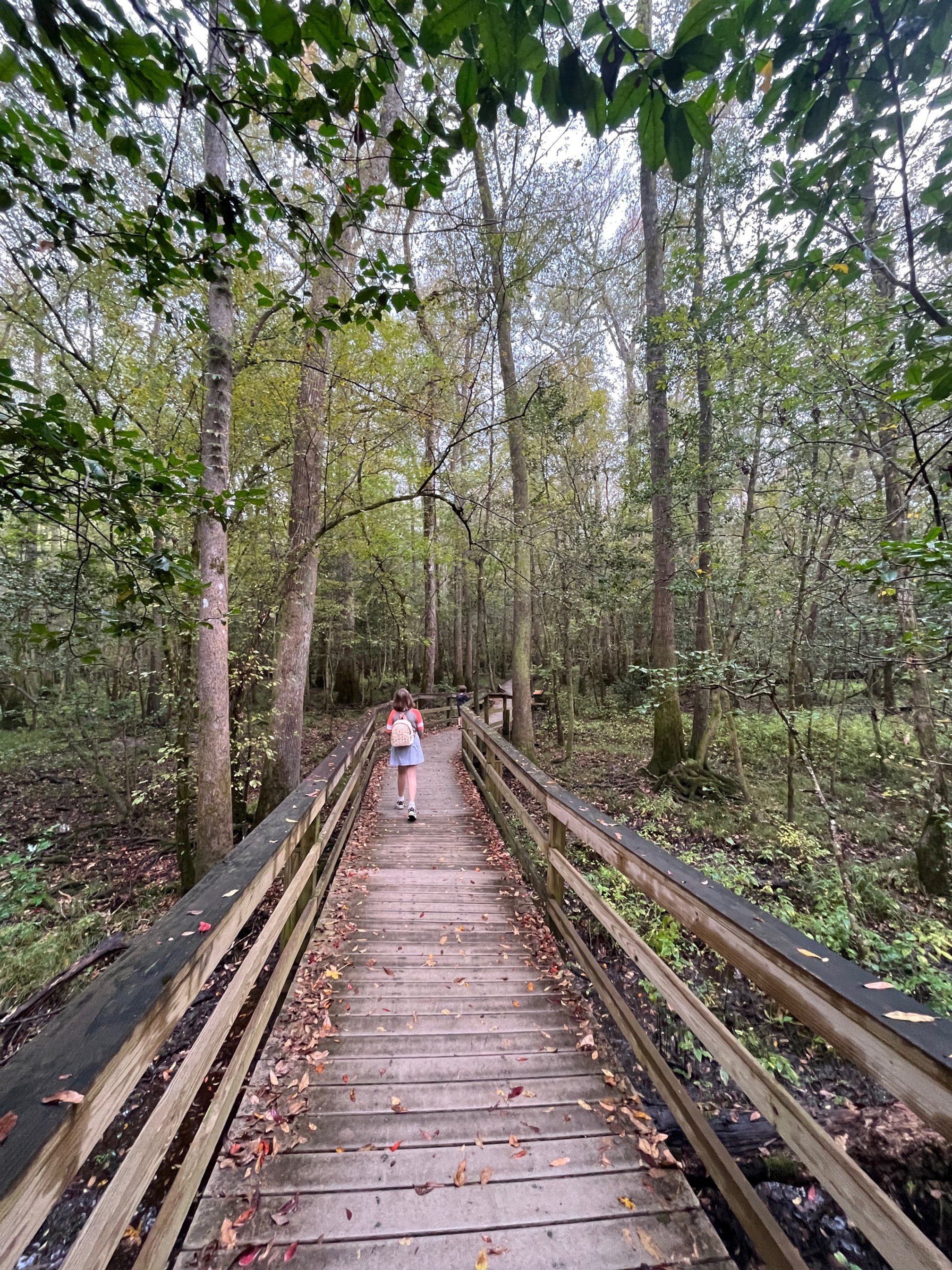
Heading into the cypress swamp areas of the trail
Cypress Swamp and Lower Boardwalk
Continue straight ahead noting that the pine trees from near the visitors center will begin to be replaced by cypress trees as the boardwalk lowers.
A few hundred feet into the hike, and you’re no longer hovering above the forest floor. You’re now in the midst of a cypress swamp.
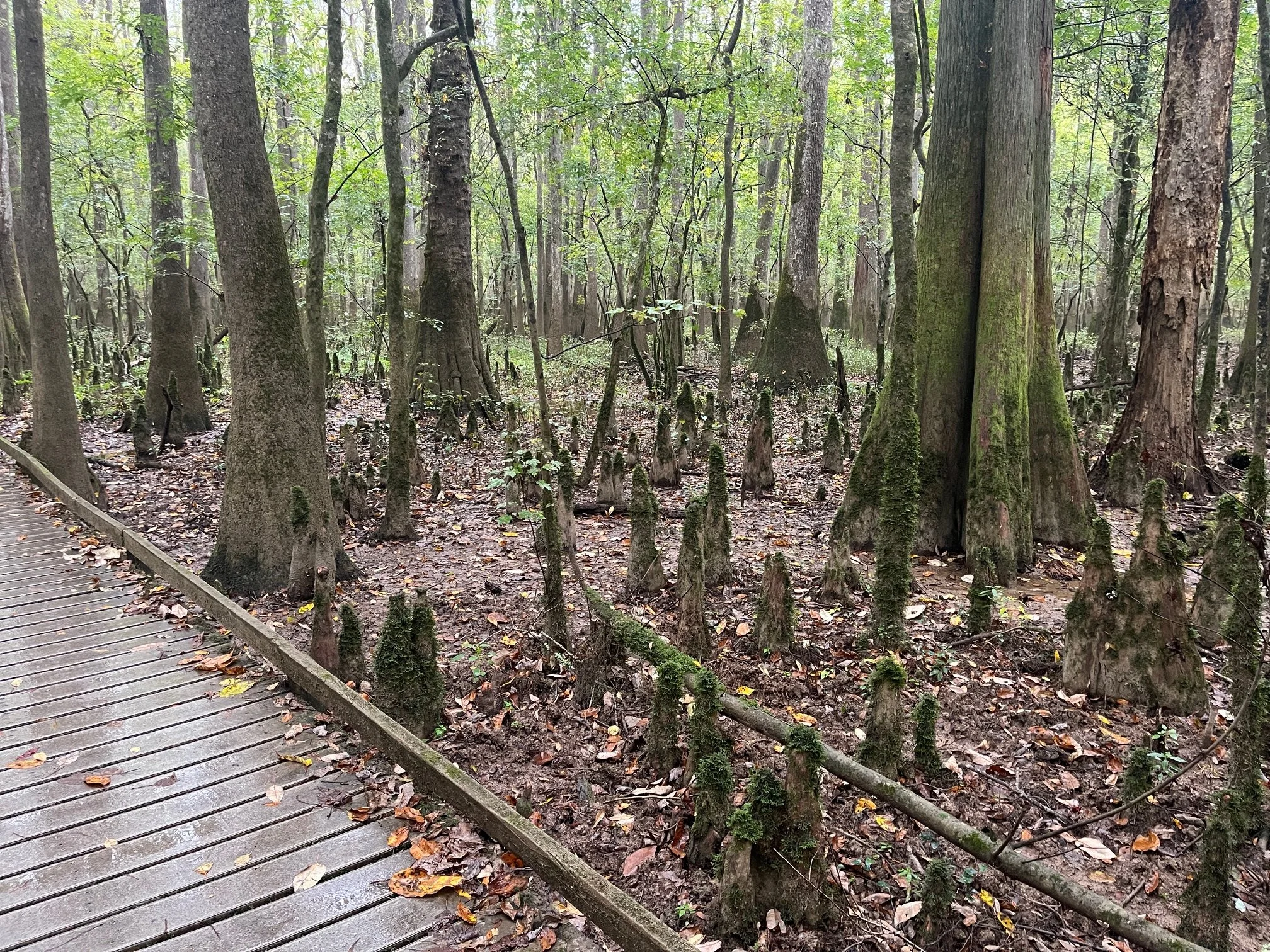
If this is your first exposure to a cypress swamp, take some time to observe the ecosystem around you.
The little wooden knobs poking through the water are called “cypress knees,” and there’s some debate on what exactly they do.
Most likely, they’re helping the tree gather more light and nutrients, but that’s not definitive.
NOTE: This section of boardwalk is lower than what you’ll find on the other half of the trail. It’s most likely to be flooded (and closed) during seasonal rains.
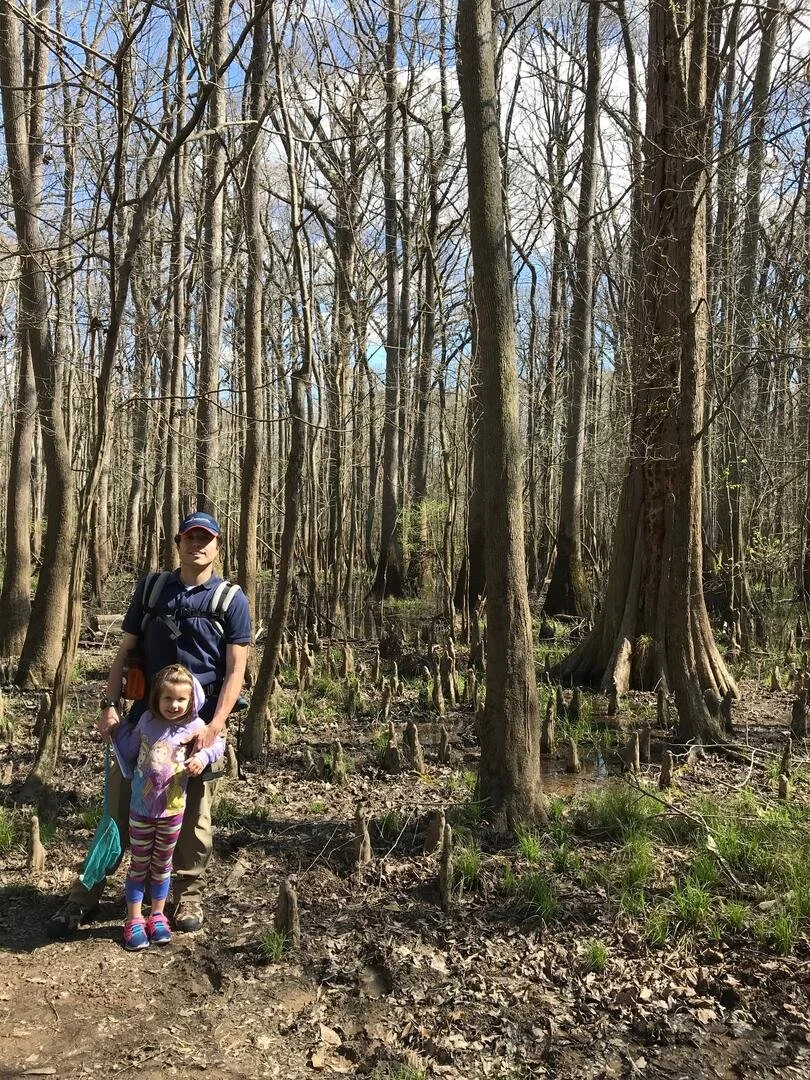
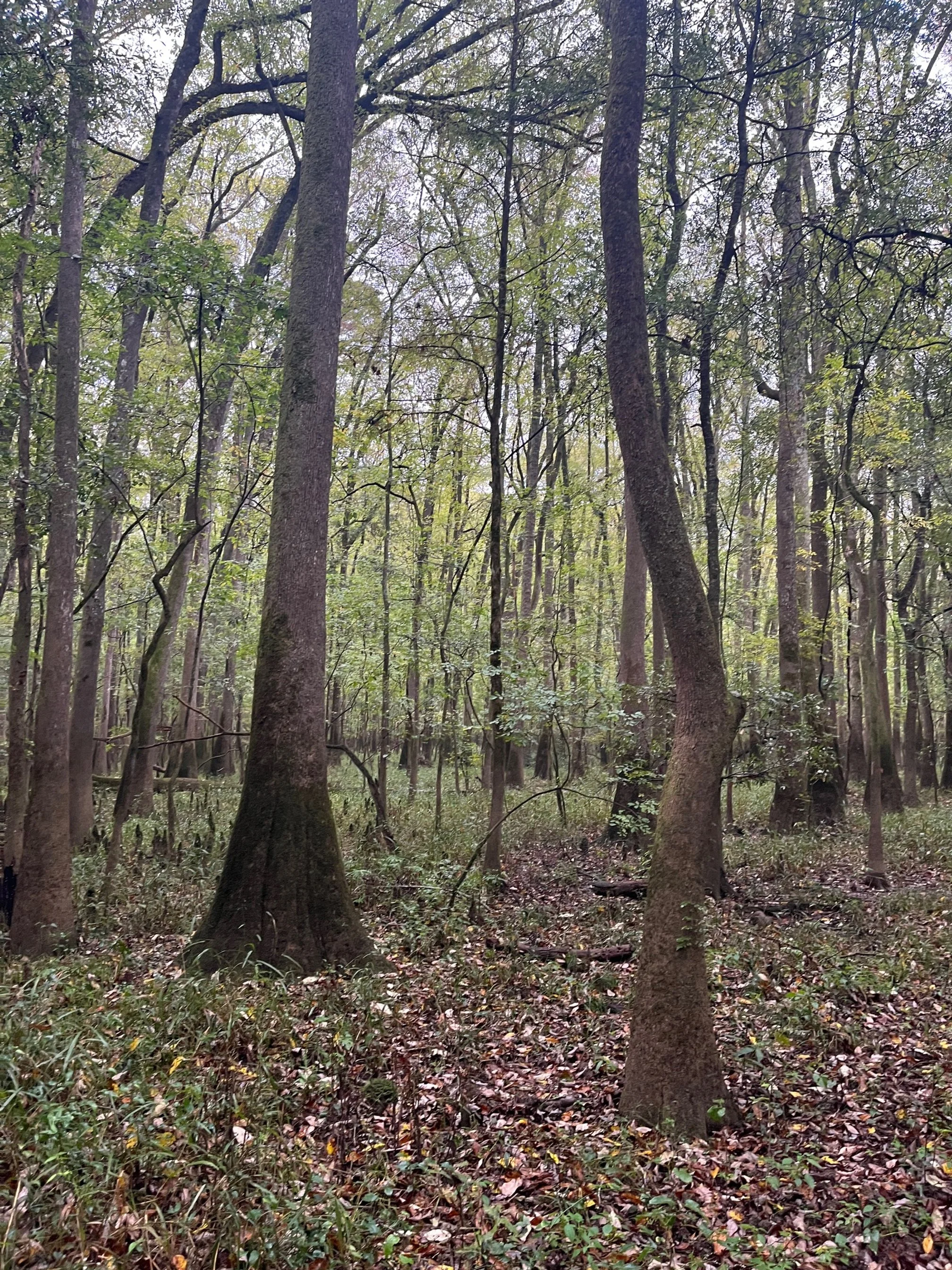
There are also a few stands of sugarcane (also known as “cane breaks”) as you move through this section of the trail.
As an aside, cane breaks are what canebreak rattlesnakes are named after. Canebreak rattlers can be found in Congaree National Park, along with a variety of other snakes.
If you do happen to come across a snake on the trail or just off of it, observe from a safe distance and don’t harm it. They tend to be just as scared of humans as many humans are of them, and will move along in time.
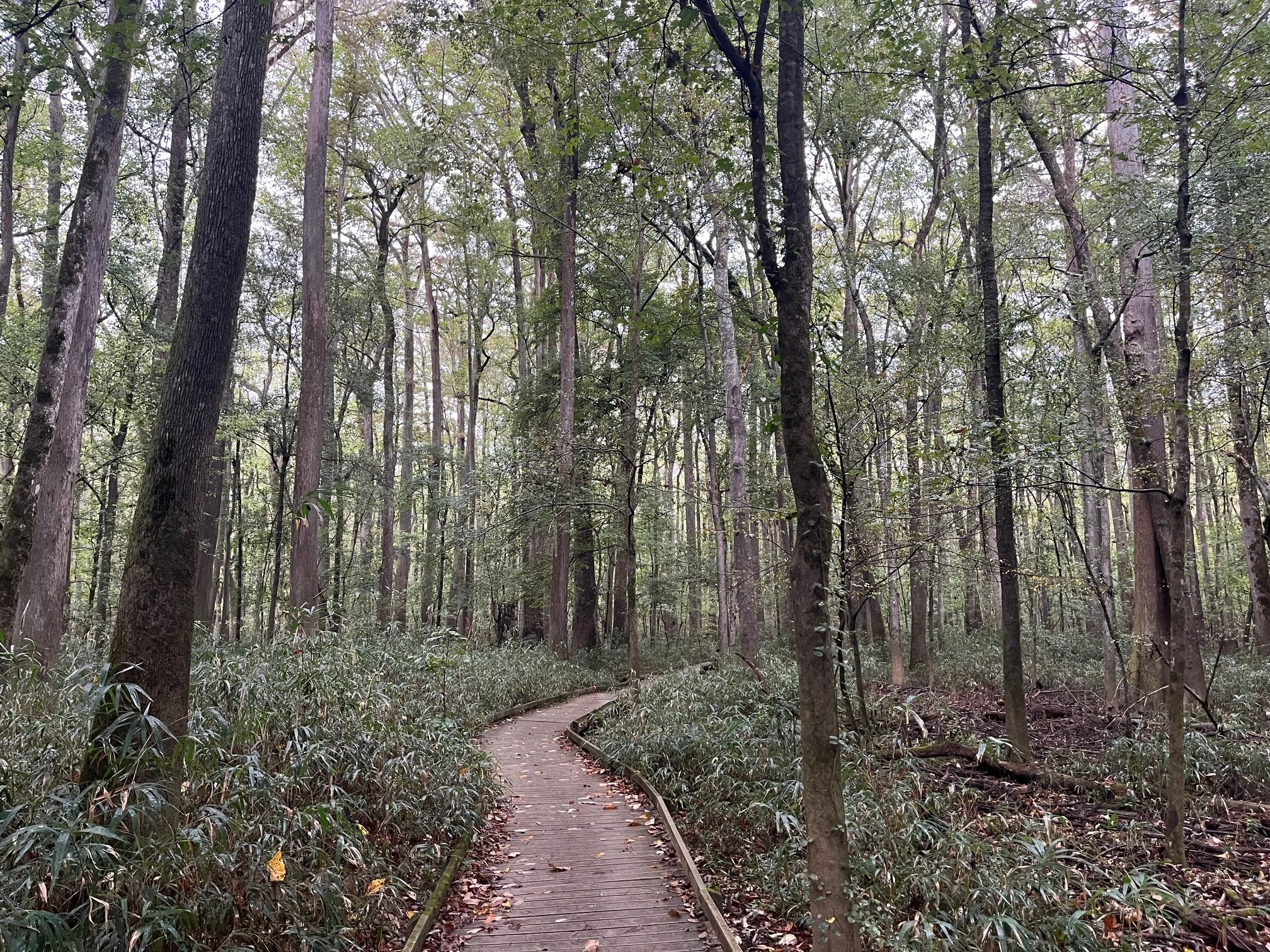
Cane breaks along the Boardwalk Loop Trail
Champion Trees
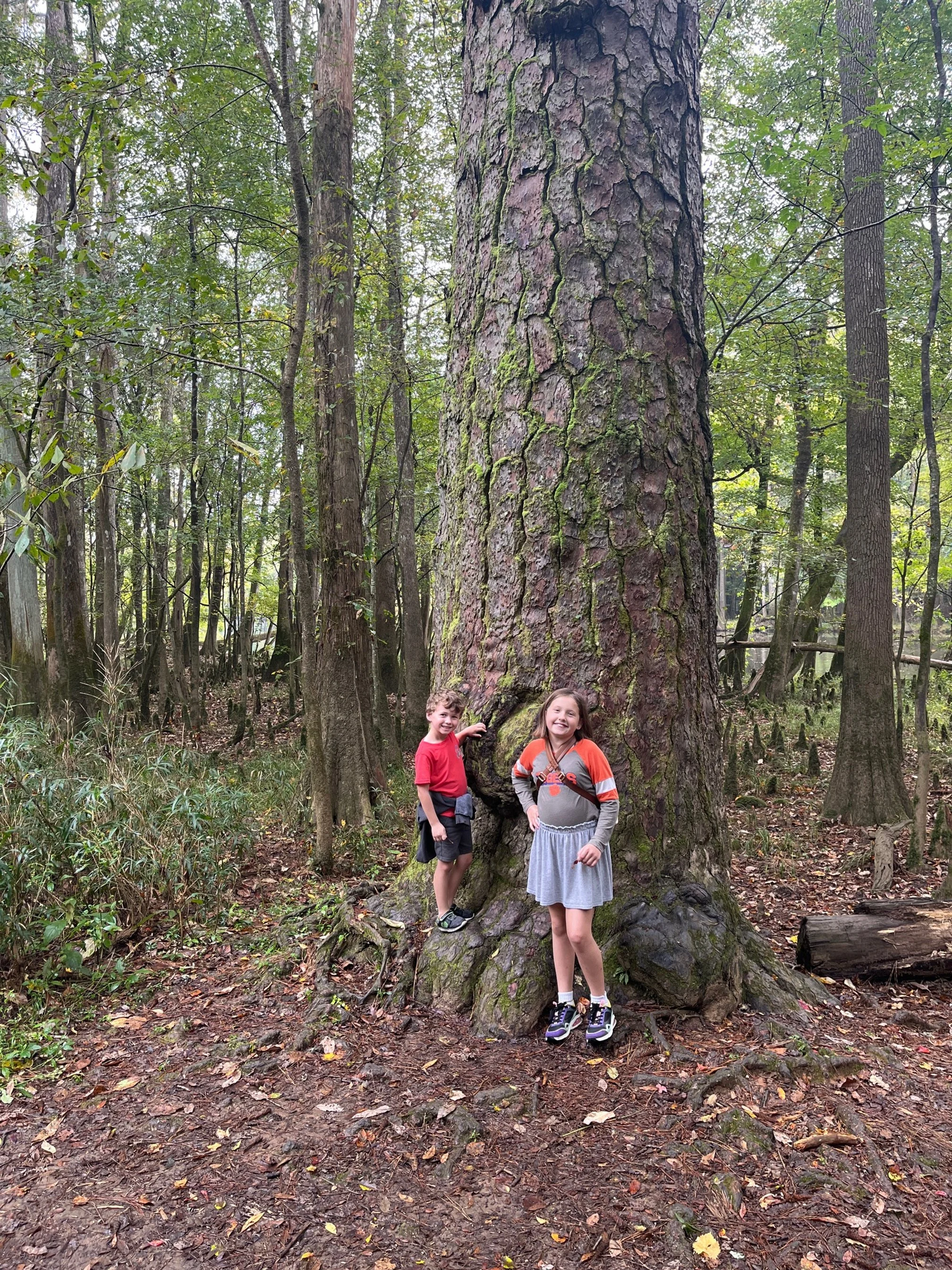
The Camping Kiddos with the largest loblolly visible from the Boardwalk Loop Trail
About 1/4 of a mile into the hike, the trail will swing sharply to the left and you’ll enter the section of the park with the largest trees.
This area of the trail is also my favorite as you transition from swamp back to loblolly pine forest. You’re at the furthest distance from the visitors center, so casual walkers have usually turned back at this point.
The trail is quiet, and you can hear woodpeckers and whip-poor-wills calling above, and squirrels, and deer in the underbrush.
You’ll also pass across the Sims Trail halfway along this leg of the Boardwalk Trail.
NOTE: If you want to shorten your hike, turn left on to the Sims Trail here, follow it until it intersects with the Boardwalk Trail, go left on the Boardwalk Trail and you’re nearly back at the visitors center.
The largest of the trees visible in the front country is the massive loblolly pine close to the stairs at the end of this portion of the trail. This tree is so big that I can’t even begin to wrap my arms around it.
At 150 feet tall, it was once a state champion, but has been replaced by the reigning champ, which tops out at 167 feet. It’s in the backcountry of Congaree’s property, so you’ll have to make a separate trip for that.
You’ll come to a small set of stairs as the trail comes to a T.
Weston Lake Spur
This is also where the boardwalk returns to the height it was at the start of the hike. This is called the upper boardwalk, and it tends to stay open even in local flooding because it is so high.
If you turn to the right on the upper boardwalk area, you’ll take a little spur trail to the Weston Lake overlook.
It’s a scenic spot for a quick pause, but Weston Lake is also interesting as it is an oxbow lake.
This means that it used to be a part of the Congaree River, but the river’s path shifted and left this patch of water behind.
Upper Boardwalk
Retrace your steps from the West Lake overlook and continue following the Upper Boardwalk, moving away from the stairs you climbed earlier.
This stretch of the hike gives you a feeling of floating among the trees since the boardwalk is so far above the forest floor. It’s a great area to look for deer, which will blend in seamlessly to the forest surroundings.
About halfway between the Weston Lake spur and the next turn in the trail, look into the woods on your right side to see if you can spot the long abandoned moonshine still.
It’s leftover from the 1920s, when Prohibition led locals to distill their own spirits in these thick woods.
Returning to the Visitors Center
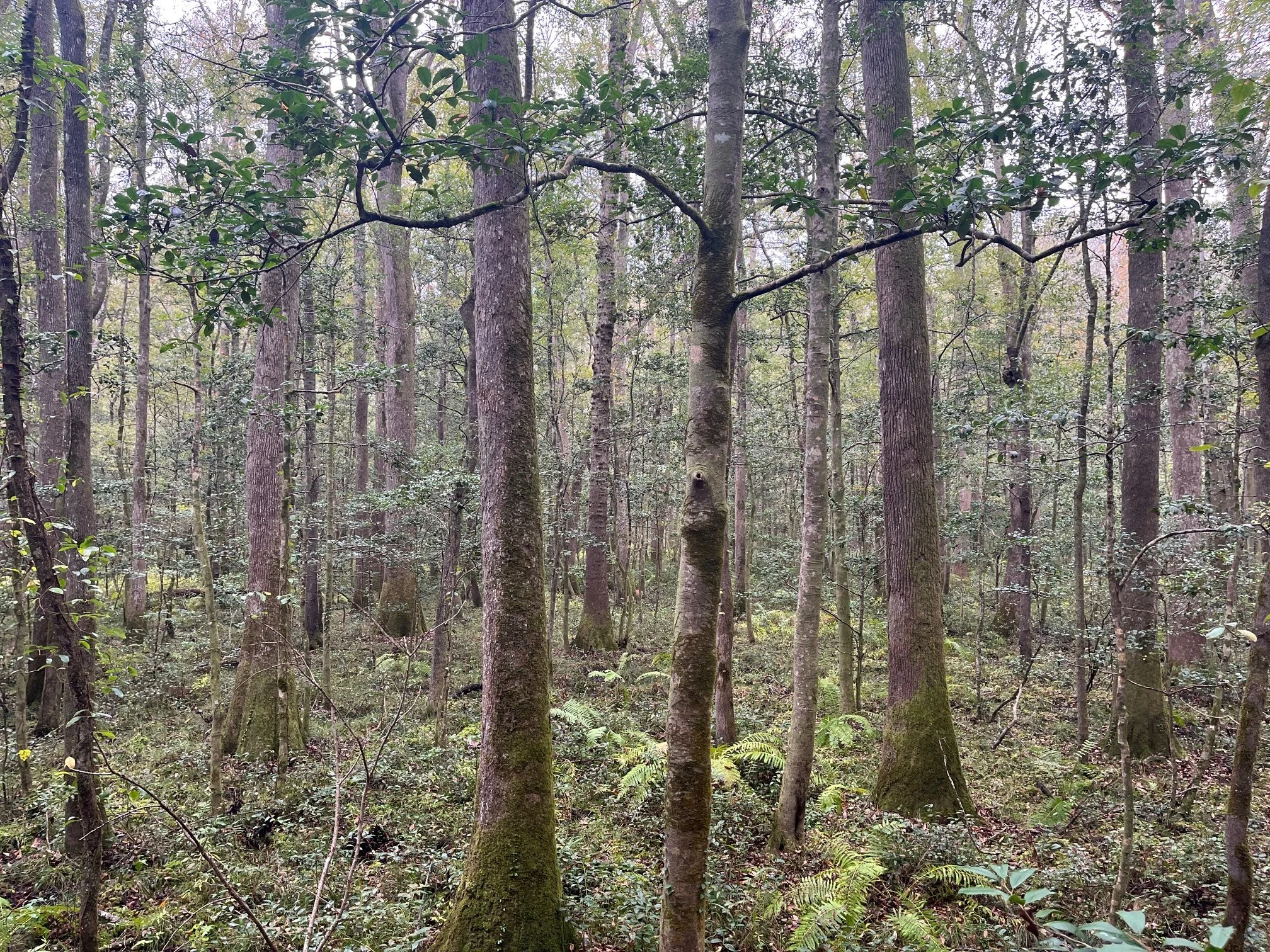
Ferns and oak trees near the end of the Boardwalk Loop Trail
The trail will make one more turn to the left as you enter the final stretch of the Boardwalk Loop.
You’ll see the Sims Trail once more as it cuts across. If you were to follow the Sims Trail to your right from here, you’d quickly get to the park’s hike-in campground, the Bluff Campground.
In less than a quarter-mile, you’ll rejoin the section of boardwalk where you started.
Retrace your steps to the visitors center or head out onto another nearby trail (the Firefly Trail and Longleaf Trail are good options).
Tips for Visiting the Boardwalk Loop Trail
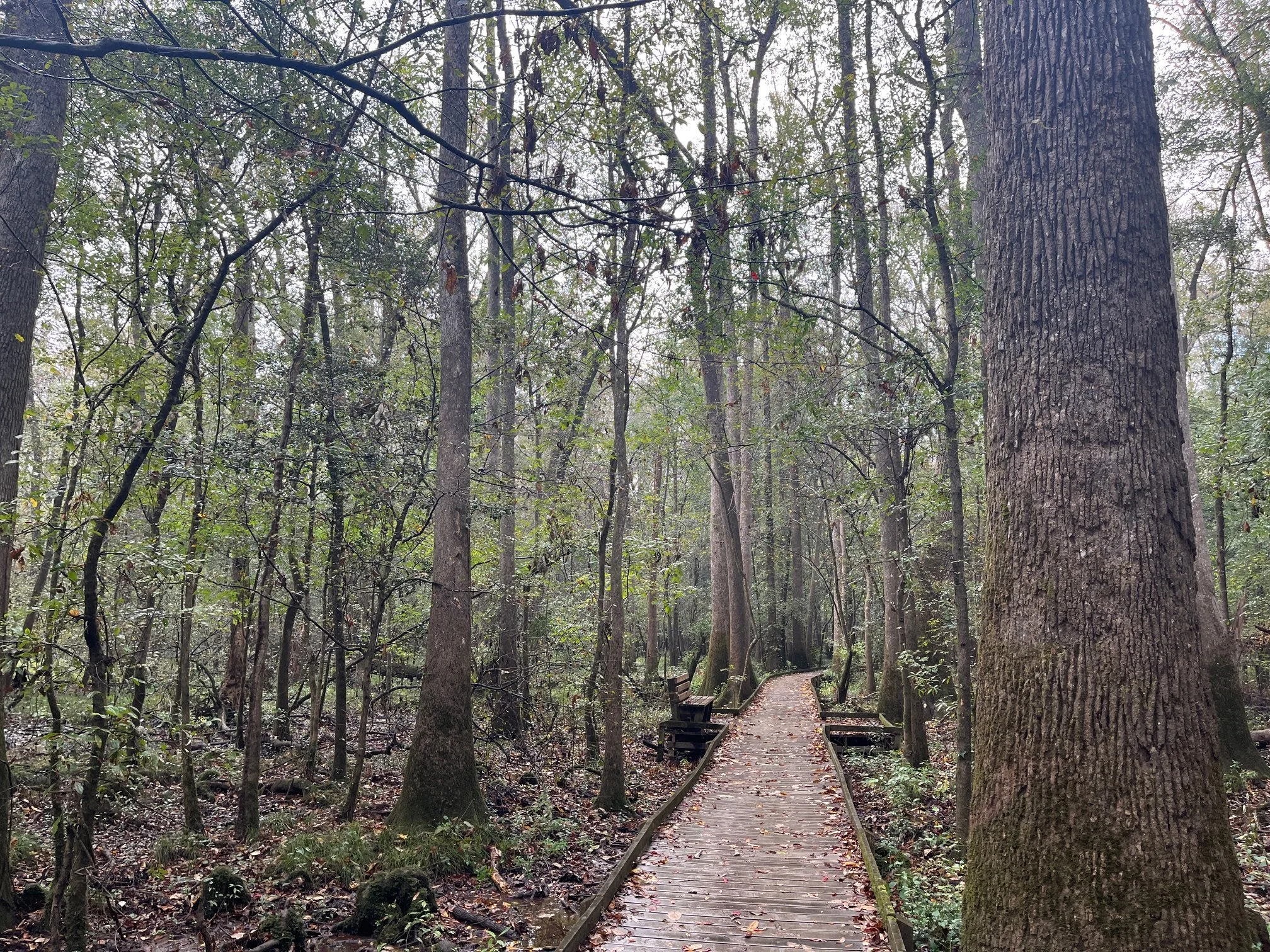
One of the many benches along the trail
Bring water and trail snacks.
You won’t find any food or drinks at the trailhead and there aren’t any concessions in the park, so you’ll want to pack in everything that you need.
While the trail isn’t long, I’ve learned (the hard way) to never, ever step foot on a trail without plenty of food and water lest my children decide that they’re underfed and completely dehydrated.
I always carry water in my day pack, usually in my 2L water bladder.
When my kids were younger, I’d carry their water for them, but they now each have little water bladder in their own packs.
The area immediately around Congaree is still very rural. You’re barely find a convenience store within 15 miles. You’ll want to go to a grocery store or convenience store in either Columbia or Orangeburg near the interstates before you venture into the park.
Wear comfortable shoes.
This isn’t a hard hike, but I still wouldn’t do it in anything less than broken-in tennis shoes.
Hiking shoes or boots are even better, as you’ll get additional joint and muscle support as you’re adventuring around the park.
In the summer months, you could wear Chacos, Tevas, or, my favorite, Keen Newport H2s, which aren’t as hot or constraining as full hiking boots.
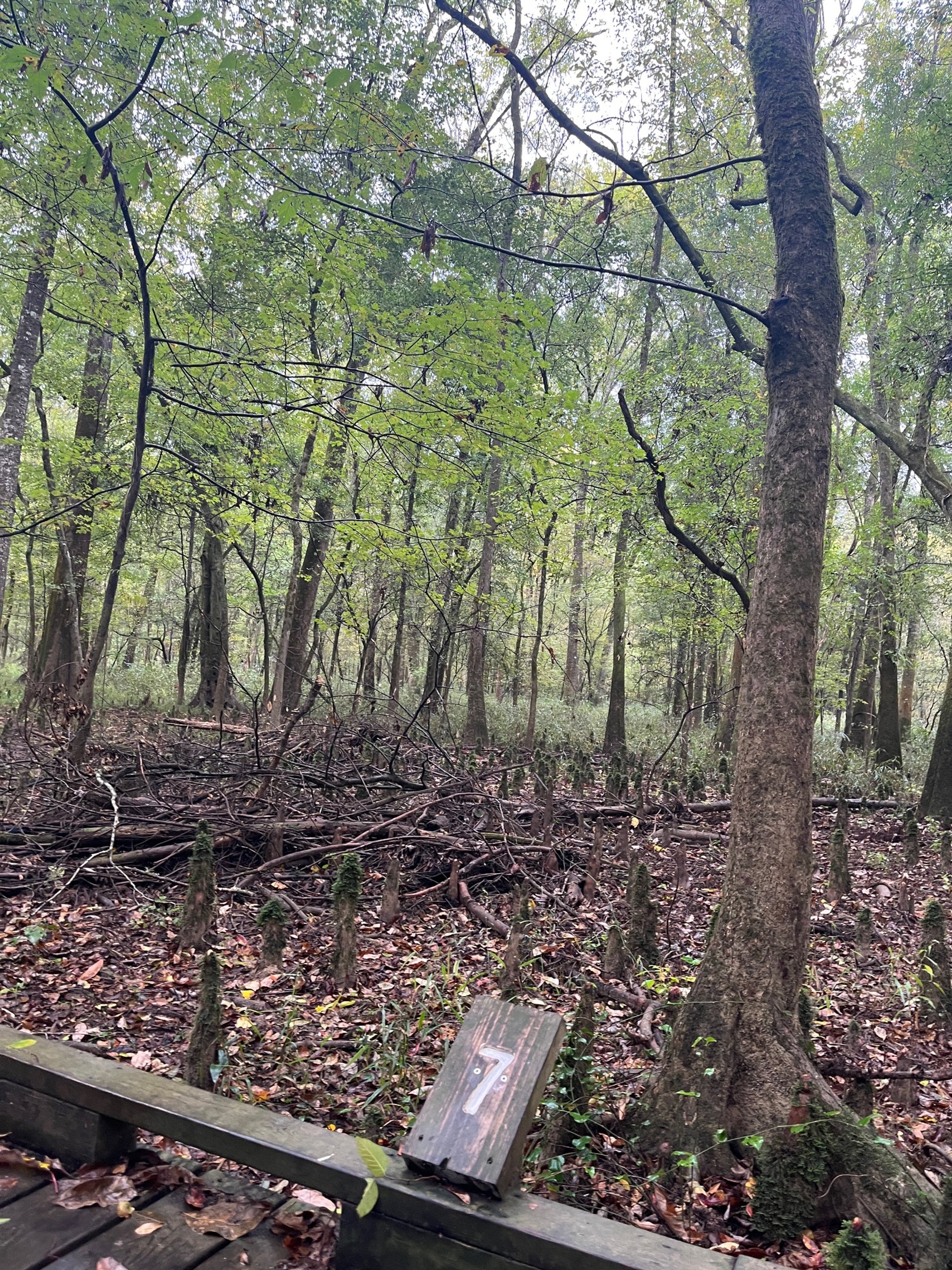
One of the markers indicating a stop on the free informational booklet for the trail
Pick up a free informational guide.
Look for the small booklet on white paper in the holders on the wall of the visitors center. These will be opposite the bathrooms.
There is some excellent information on this guide, which will help you better identify specific trees, elements of the ecosystems, animals, and more as you walk through the boardwalk.
Each of the brochure’s information points corresponds with a number that you’ll find along the boardwalk.
If your child wants to learn alongside you, be sure to grab a free Congaree National Park Junior Ranger booklet from the information desk.
These are easily done during a short visit, and my kids always love trading in the completed booklet for another Junior Ranger badge.
New to visiting the national parks? Check out my guide to the national parks for beginners!
Pack a picnic.
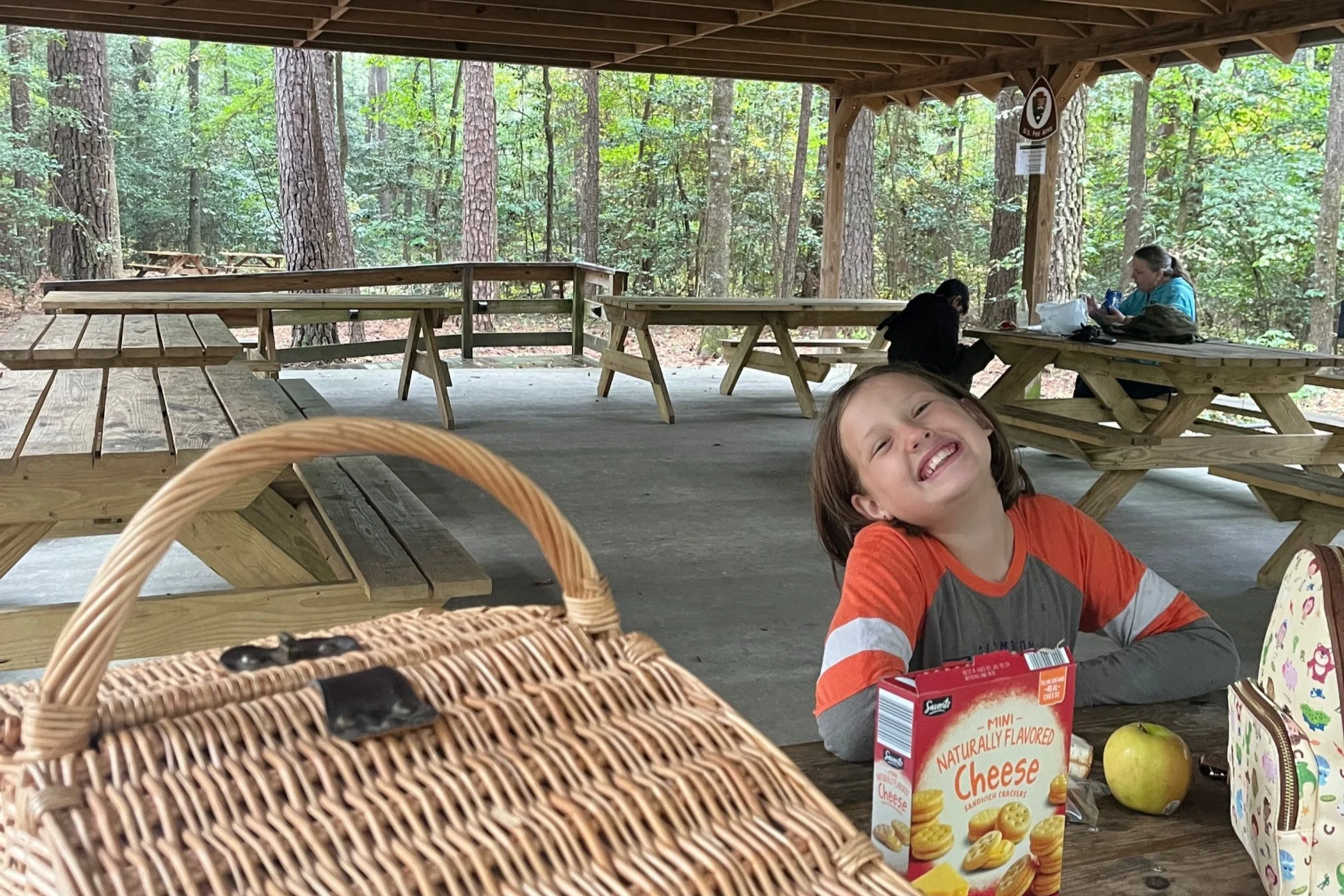
The covered picnic area is a great place to rest for a moment during your day.
While you’re on site, you might as well make a day of it.
Before or after your hike on the Boardwalk Trail, enjoy a picnic at the covered shelter near the parking area.
You’ll find several large wooden picnic tables on a poured concrete floor.
Check ahead for seasonal closures.
This area of the Congaree River floodplain is dynamic, and can go from bone dry to flooded under several feet of water in less than a day.
The southern sections of the park see the worst of the flooding, but, in particularly bad floods, portions of the Boardwalk Trail will be flooded nearly to the visitors center.
Check on the official Congaree National Park site. The rangers try to keep it updated, but there’s still the chance you’ll arrive to find a sudden flood covering portions of the park you’d like to see.
Bring bug spray.
If you listen to any piece of advice that I ever give on this site, it’s this: bring bug spray to Congaree.
And, if possible, only visit in the fall, winter, and early spring.
The bugs grow big down in the swamp and you will get bitten by mosquitoes in the warmer months.
It’s sto bad that the park even has a Mosquito Meter by the visitors center to help parkgoers determine just how bad the bug situation is at any given point.
It’s important to time your visit right. Here’s my guide to the best time to visit Congaree National Park.
Explore more of South Carolina’s beautiful outdoors:
Final Thoughts on the Boardwalk Loop in Congaree
The Boardwalk Loop Trail isn’t the most challenging that you’ll ever do.
But it is a fascinating glimpse into an ecosystem that’s all but disappeared in this part of the country.
This short, easy hike throws you into some of the best that Congaree National Park has to offer, and it’s unlike anything else in the national parks system.
If you still can’t get enough cypress swamps, there are several others nearby in South Carolina that are worth checking out, including:
Edisto Gardens in Orangeburg,
Francis Beidler Forest in Harleyville,
the Wateree Passage of the Palmetto Trail (only 10 miles from Congaree!), and
Caw Caw Interpretive Center in Ravenel.
Let me be the first to welcome you to this incredible part of South Carolina. I hope you enjoy your hike along the Boardwalk Loop Trail and beyond.